Don’t Just Tweet Your Booth Number

hashtag blog-970723_1920


Tweeting your booth number = Junk Content

You know it’s getting close to the big annual conference in your industry when every supplier starts Tweeting their booth number.

My team, colleagues, and friends are gearing up for #IFA2016 from the International Franchise Association and we’re seeing it all over the place.

These companies don’t share anything all year then suddenly think, “Hey it’s nearly convention time. Now what was that Twitter password…?”

They’ll log into Twitter to let the world know they’ll be at booth #123.  Oh and they’re giving away an iPad, because everyone will flock to the booth for that. And then they’ll go silent for another 11½ months.

Twitter is dying my friends. And it’s mostly because of junk content like that.


If Not The Booth Number, Then What?  

A few weeks ago, my Social Geek Radio co-host Deb Evans and I discussed some other things to share on social that might give some more value to your fellow conference-goers. Here are a few from our podcast:

  • Share details on a speaker you’re looking forward to hearing.
  • Post about a topic that’s on the agenda and get an engaging conversation going ahead of time. (This is what I like to do most)
  • Ask who else is en route and suggest meeting for coffee and chat. (This is what I need to do more of myself!)
  • If you’re familiar with the location, share items about the history, food, entertainment, transportation, or anything else out-of-towners might find interesting. (Deb is great at this)


But What About That Booth We’re Paying For?

Can you slide in a mention or two of your promotion? Absolutely! But I always suggest your social content be at least 80% about OTHERS and at most 20% about YOU. So after 4 or 5 updates on Twitter, Instagram, or Facebook about the conference or other people participating, go ahead and share something about your promotion, contest, giveaway, or trade show activity. As long as this isn’t the only thing you’re pushing out, it’s cool.


I’ll be Tweeting a couple of booth numbers later this week for the IFA Convention myself, to let anyone interested in the Social Geek Radio podcast know where they can join us live. In fact, I’ll post it now! We’ll be at the Manalto booth (#461) on Sunday 2/21 and at the 1851 Franchise booth (#134) on Monday 2/22. Now that that’s done, it’s back to more posts about Others. See you at the show!


IFA SGR live 3


Facebook Live Mic Drop

facebook-1138515_1920

I’m not sure if Facebook just dropped a mic or a bomb on Periscope and Meerkat. Facebook Live is replacing every cool feature of those live streaming mobile video apps with the friendly space where most people you can hope to know already live.

If you still think that Facebook isn’t eating the internet, think again. Here’s the recent scorecard:

Facebook Features                             Platforms That Were Important 5 Minutes Ago

Facebook Live                                        Periscope, Meerkat

Native Video on Facebook             YouTube

Facebook Reviews                              Yelp and all other review sites

Facebook Pages                                   Your corporate website

Facebook Instant Articles               Every newspaper and magazine on Earth

Facebook Ads                                        Everything else


The Fate of Email: Who Is Reading It?


spider-monkey-637062_1920

A long time ago in a place far away, the phone rang and you answered it. You actually ran to the phone. Then came answering machines, which took away the peril of running to the phone. Then came caller ID, which filtered out any unwanted conversation. Now every phone has a big red DECLINE button and it’s amazing that anyone ever answers your call.

Your email is now in the same danger. 15 years ago people were excited to hear “you got mail,” read it, and dashed off a reply immediately. Now they see most email as some fresh hell that will steal their time .  

If you’re using tracking software to see the open rates of your emails, you are amazed at the number of people who just don’t open any email. If you’re not using tacking software, let me quite bluntly update your on your email effectiveness right now:

Did they get the email? Yeah, they got it.
Did they open it? Probably not.
Will they reply? Probably not, unless they need something from you!

Mass email marketing service providers will tell you that email is still the most important and efficient way to get your message to your audience, customers, and other consumers. But will it actually be read?

Here are a few tips to increase the likelihood of your message being read:

  1. Make your email like a text. Put the entire question in the subject line. It can be read on any phone, so even if they don’t open, they will see your message. If they don’t respond, then that’s another issue.
  2. If you do put your question or request in the body of an email, don’t make it any more than 2 or 3 sentences. That’s all that will be read anyway.
  3. Use tracking software to see which of your colleagues never open your emails. For those culprits, you will need to text them, or perhaps even pick up the phone and surprise them!


Digital Trends with Scott Monty on Social Geek Radio


scott 1

This week’s special guest on Social Geek Radio is Digital Marketing leader Scott Monty!

We’ll chat about Marketing Trends, the Auto Industry, Sherlock Holmes, and everything else in Scott’s wheelhouse.

Download Wednesday night at 8pm ET:
http://socialgeekradio.com

Subscribe now to Social Geek Radio on iTunes:
https://itunes.apple.com/us/podcast/social-geek-radio/id372755526


Also, check out Scott’s weekly newsletter covering the latest news in digital marketing each week!

SM-Logo


Posting Content Over Christmas Vacation?

christmas-621358_1920


Some content marketers see the last two weeks of the year as down time. Do you?

You may believe that consumers will be spending time with their families, engaged in conversation, and too busy traveling to see your brand’s content.

This may have been true in 1989. But now at family gatherings, even Grandma is checking her phone. Families will be showing each other things they like online, the kids will be on Snapchat, Mom will be sharing images of her festive food and holiday loot with absent friends and family on Instagram, and Dad will read some blogs while checking email (and playing Clash of Clans).


More Travel = More Time on Social

Traveling once meant brands could not reach consumers while they’re away from their favorite media for a week. But now every extra minute delayed at an airport or sitting in the back of the Family Truckster means more opportunity for content to be seen. And let’s face it, after days together with family, most of us need to escape into our devices. 

griswold-blackhawks
If the Griswold’s Christmas was happening now instead of 1989, they would all have their faces buried in their iPads and iPhones.


New Devices = More Time on Social

And speaking of devices, people are getting new gadgets! Lots of people will be spending quality time spent with their new iPhone 6S or new iPad Pro. Give them something new and interesting to read! And if they didn’t get the gifts they wanted, they’ll be diving into Amazon to buy something else.

cousin eddie2
Even Cousin Eddie will be on Facebook throughout his extended visit.


Tips to Win The Season

Your competitors and many brand marketers are not paying attention and may have left an opening for consumers to see more of your stuff.  In the fight for attention, there may be a great opportunity with more consumers on social and fewer brands on social! Some suggestions:

1. Schedule posts ahead of time. I’m not suggesting that you work 24/7 over the holidays. Schedule two weeks worth of posts now for all of your brand’s pages. If you need some help on this check out Manalto.

2. Double down on Facebook. Play the odds with the platform with the biggest audience. The extra online activity outline above includes a stop at Facebook. Your focus here should be sharing videos, native Facebook videos, not links to YouTube. Bonus – Here are 10 new tips from a Facebook Product Manager on publishing videos: http://media.fb.com/2015/12/11/10-tips-for-using-video-publisher-tools-on-facebook

3. Holiday Reruns! If you don’t have time to create 2 weeks worth of content in the next couple of days, look back over the past few months and reuse some of your favorites.


Don’t Redo Your Website in 2016

chalkboard-620316_1920


“No one’s looking at our website. Quick – redesign it!”  

But if no one’s looking, then why waste resources? With marketers changing jobs so frequently, it’s easy to fall into the trap of changing websites along with the marketing professional.  The new head of marketing joins the company, and his first move is to redo the website. Why?

  • It’s what he knows how to do.
  • It has the old head of marketing’s mark on it.
  • He’s got a long list of loyal vendors or old teammates who can do the job.
  • Refreshing a website is safe, while trying something new is risky.

None of these are good reasons to change your current website!

And, the CEO knows just enough about marketing to be dangerous and say, “Sure, it makes sense to do a new website. The internet is important, right?”  

The problem is that no additional customers will see the new site versus the old site unless you are actively attracting viewers.


What should you do instead?


1. Turn your corporate website into a blog.

Maintain an active blog page as your “main” landing page of your company’s website. Keep it fresh with new stories about your customers, industry, and brand.

Search engines like articles better than corporate pages. And, so do your customers!

Links to your blog posts give you “stuff” to put on Facebook, Twitter, and LinkedIn. Seriously, aside from fresh blog posts or articles, what else from your corporate site could you share on your Facebook that anyone would want to see? A link to your “about us” page or your pricing page? Hardly!


2. Focus on Facebook

A no-brainer? Yes, to some. But we still see resources going into audience-free corporate websites, rather than the online places where your customers are already living.

Your Facebook page isn’t even the most important thing to focus on.  The posts that you publish – and pay to boost – are what will appear on your customers’ feeds are the key.


The 2016 Model of Google +

GooglePlus-logos-02


Like an aging car model, Google+ has a fresh new look for the coming new year.

I was a huge proponent of G+ for many years. Since its inception, I have told countless peers, friends, clients, and all marketers that they must get on Google+ now, share your brand’s content, and engage! 

With the new model of Google+, I can tell you now that I’m not so sure how to tell a brand’s story there. And, the chances of engaging with customers are nearly nonexistent.

Of course, there’s still an important SEO factor. But this will be replaced by search results showing consumers your Google My Business page, Google Places page, and your brand’s website. (Until 2017 when we make all websites irrelevant and just drive people to your Facebook page. But I digress…)

Through the lens of content sharing and engaging, Google has succeeded in taking the social out of social media marketing. There’s just no one engaging. And most of all, I don’t see a path for marketers to pull in new fans and customers to G+ pages and compel them to “follow” the pages, when the pages are now harder than even to find. 


Recommendations for using G+

I recommend not spending much time or many resources on Google+. However, sometimes when everyone else is going another way on social media, it just might be worth hedging a bit and trying one more time, perhaps from another angle.

So if you’re marketer who’s not yet ready to give up on Google+, or if you’re true Social Geek and want to check out Google+ again, here are a few recommendations and tips:

G+ Tip: Use the mobile version only

It’s mobile or nothing. Maybe you’ll want to use the desktop version to set some things set up but then walk away.  There are just too many areas to make the desktop version usable by anyone. People? Well, business pages are here too. Pages? My business? All of the confusing navigation from the desktop version is missing in the mobile version – and I’m glad!

In the mobile version, there are only 3 areas:

1. Home – feed of updates from your friends and brands you follow (just like Facebook, and just like the “old” Google+).

2. Communities – like a more visual Facebook or LinkedIn Group.

G+ Tip: By sharing things here, we can reach and engage with people without “friending” them and letting them into our personal lives (what many are hesitant to do on Facebook).

3. Collections – like Pinterest or Instagram; you’re sharing images of your favorite things.

G+ Tip: When you add a post to Communities or Collections, it also adds to your timeline with an indicator that it’s also part of the other group. No need to add twice!

G+ Tip: share photos and text from the mobile version, try to avoid sharing links for now. An early glitch shows that when saving a link to a blog post, the photo I chose to be the thumbnail does not appear in the mobile version of the same post.


For further discussion on the new Google+, please check out this week’s Social Geek Radio podcast!


Happy Thanksgiving! Oh My God, They’re Turkeys!

Les WKRP 2

Theatre of the Mind

In 1978, television give a big Hat Tip to radio’s “theatre of the mind.” On WKRP in Cincinnati, you “saw” the whole horrific turkey drop, but you never actually saw a single turkey! 

Arthur Carlson WKRP
Art Carlson: “As God as my witness, I thought turkeys could fly.”

The art and science of radio allows for intriguing storytelling due to the need to describe in detail the events and subjects.

reagan-30s-who

I recently listened to a fascinating interview with President Ronald Reagan from the mid-1980s discussing his early stint broadcasting University of Iowa football games on WHO-AM Des Moines. When asked if he would have moved into TV sports broadcasting if he hadn’t gotten into film and eventually politics, he surprisingly said no. He felt that his strength was verbally telling the story and painting a picture of the action. Radio needed that, but Television didn’t.

Podcast Storytelling

All marketers talk about storytelling, but most have bypassed content marketing in audio form. Podcasting may be the simplest and most cost effective way to reach a targeted (and potentially large) group of customers. You share industry news, discuss relevant topics to your customers, and tell your brand’s story. And you don’t need studios in Cincinnati, Des Moines, or anywhere else to get the word out.

Mass versus Niche

One of the issues with terrestrial radio that lead to today’s listenership challenges was the race to appeal to too broad of an audience. The strategy of least offensive programming where stations and groups played content that neither turned off nor inspired listeners created a universal blandness up and down the dial.  

With podcasts, no niche is too small and no subject is too inside. Podcasters aren’t aiming for mass audiences; they’re connecting with smaller, specific audiences.  

For more on content marketing and social media, please join me on the Social Geek Radio podcast. The show airs Wednesday evenings, and is free via download here or on iTunes

Curated Content Is Like a Holiday Rerun

Mr-Heat-Miser1

Just a few months ago, I was much more of an advocate for aggregating and curating content on social media channels. I saw the need for sharing content created by others as an important part of your digital marketing strategy.

However, it now may be time for many brands to tell their story more, and share others’ stories less.

Curated content is a rerun

When I speak with marketers about social channels and how content works with audiences, I frequently draw comparisons and analogies to television programming. Curated content is a rerun. As the holidays approach, TV networks will start relying more on reruns. What are they saying? That they’ve given up on having much of an audience at this time.

By running too much non-original content on your social channels, you’re saying the same thing.

Reruns aren’t all bad

Look at the huge ratings for constant reruns of The Big Bang Theory on TBS, and Seinfeld running in syndication for nearly 20 years. And every year networks trot out Rudolph, Frosty, Heat Miser, and the rest of the 40-year-old animated shows.

But it’s a rerun. It’s not original. When you share a lot of aggregated stories, your audience has probably seen it or something similar already. Worst of all, you may get a bit of credit for sharing the nugget, but your brand is not the star. You’re telling someone else’s story.

As mentioned earlier, I used to be much more of a proponent of posting content created by others, especially popular content. My aim was to promote the idea of just getting something on those empty pages – and with any luck, something popular. But now no one is paying attention to your Facebook page anyway; they’re focused on their Facebook feed. And hopefully you get a little portion of that feed where you’ll have the opportunity to get their attention.

Be the TV Programmer

So think of your page as your own TV network, and use curated content only to fill those holes when you don’t have a new blog post or original video or podcast to share. And when you do share others’ stuff, it may make sense to get share the work of business partners, channel partners, friends in the industry, and other marketers you know. Perhaps they will reciprocate on days when their programming is running dry too!


Facebook Custom Audience Targeting with Your Emails

bows-and-arrows-650474_1920

It’s been said over and over that Content Is King. Sure. But if the content is never read, viewed, or heard by anyone, then it’s not very royal.

If content drops but no one sees it, does it make any impact?

You must spend some dollars on advertising to promote your content or no one will ever see it.  But what’s the best way to throw some money at this problem? Advertise to only to targeted demographics or geography? No.

Take one step back – do you have email addresses of your current or recent clients? Let’s start there. Facebook’s Custom Audience Targeting allows you to serve up that ad to a specific group of people for whom you already have an email address.

Facebook won’t let you pick and choose specific people by name to whom an ad will be served but we can serve up ads to people whose email addresses match! In Facebook’s view, if you’ve already got an email address, then there’s a reason to speak to these people in specific voices.


Here’s for whom it works:

Business to Consumer – Create targets ads for:

  • Your current customers
  • Specific customers part of your loyalty program
  • Potential customers who have signed up for specials or info

Business to Business – Create targeted ads for:

  • Prospects and candidates


Here’s how it works:

FB1 cat

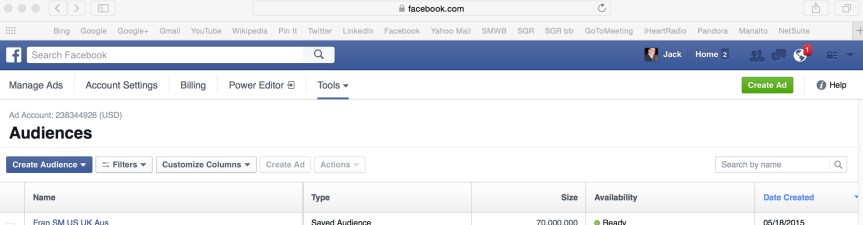
1. Go to Manage Ads on Facebook and click Create Audience button (far left)


FB2 cat

2. Choose Customer List
.

FB3

3. Click Upload File and select your spreadsheet with your email database


One issue to watch is the percentage of your email database that matches with Facebook users. One large franchise system with whom I spoke at FranTech 2015 has seen a match of between 60 – 70%. And an even larger global brand client of mine saw only about 50% match. Why the discrepancy? Consumers are signing up for your offerings with a different email address than what they used to sign up for Facebook.

But still, specifically targeting half or more of the people in your email database is a fantastic and economical way to reach your customers.