Proof That PR Drives Sales!

This week’s PRWorkbench guest blogger is Thomas Scott, VP of Operations for Showhomes. Thanks to Thomas for these great observations made at last week’s Franchise Update Conference.

Franchise Industry Execs Miss the Opportunity to Leverage Franchise PR to Drive Sales

P1040751300 franchise executives converged on the Drake Hotel in Chicago this week for three days of intense evaluation about the state of franchise sales and dialog about best practices that drive results in today’s market. This much anticipated Franchise Update Conference centers around industry reports on numbers of franchise units sold, lead sources for the year, and cost per franchise sale.

P1040747


This year’s theme, Mission Possible, held lots of promise as the previous year has been a wasteland for many companies. This year three big issues converge into a perfect storm that creates lots of choppy waters for franchise sales:


  1. Fran Data experts projected that the franchise industry will have some truly choppy waters for the next four or five years due to lack of bank financing and shaky loan underwriting making credit hard to come by
  2. Traditional powerhouses of franchise sales lead generation have trailed off significantly; franchise portals in particular are not delivering the quality leads they once were
  3. The dramatic shift in the way people communicate and build trust and how this impacts the rise of social media left more than a few companies struggling to connect the dots

A big disconnect with franchise sales lead generation centered on an old-school tool: Franchise PR. Here’s a list of lead sources for franchise sales this year:

Lead Sources for Franchise Sales (where leads for franchise sales come from)

  • Internet          34%
  • Referrals          28%
  • Brokers            17%
  • Print                  8%
  • Other               13%
  • Trade Shows      3%
  • PR                    3%

Sources of Closed Franchise Sales (Where the leads that actually closed came from)

  • Internet          50%
  • Brokers           16%
  • Trade Shows   13%
  • PR                 11%
  • Other             10%

Franchise companies only generated 3% of the total leads for franchise sales this year. Only 3%! Those measly 3% of leads resulted in 11% of the total industry unit sales this year. 11%! Making matters worse, almost half of the companies represented at the Franchise Update Conference were not using PR to generate sales leads. HALF!

The Franchise Update report also gave out projected average budgets for franchise development: the average company will spend $162,000 on its total budget to sell franchises this year. PR was way down on the list of expenditures. If PR done poorly and without consistency produced 11% of the franchise sales last year, what should you budget to grow a franchise system?

Franchise companies need to wake up – PR if used correctly by someone that understands the social media shift is a powerful tool for franchise sales lead generation. PR firms need to wake up too. What PR worked 20 years ago and even what worked last year DOES NOT WORK in today’s market.

Here’s the issue: publicity is great. Publicity will get you in the papers and can help with search engine optimization and Google search results. Publicity can generate a binder full of clips. Franchisees love publicity because it’s great for the ego. Publicity does not, however, generate franchise sales. Old-school press releases about store openings, expansion plans and staff changes don’t have the oomph they once did in today’s social media market.

PR can be used to aggressively drive your franchise sales if you focus on telling your story and driving the social media conversation about what you do. We’ve successfully done this at my company, Showhomes, and I listened to Stan Freidman, CEO of Retrotax talk about how he has used it to get his new company off the ground.

Success with PR centers around the story you tell. If you can get people talking about your sales effort in social media arenas like Linkedin and Twitter, you can get reporters to bite and that will lead to lots of online trust and credibility. This is crucial because candidates are at their lowest trust level any of us have seen.

They call this the ‘Great Recession’ for a reason!

For more information from Thomas Scott, please contact him at:

Thomas Scott
VP Operations, Showhomes
615-483-4923
tscott@showhomes.com
www.showhomes.com
Twitter: @showhomesthomas
Linkedin: http://www.linkedin.com/in/thomscott

Death of PR Spam

PR Spam took a few more hits last week. First, blogger Gina Trapani created a new wiki of PR agencies who have spammed her via press release. 
 
Secondly, MatchPoint rolled out a new version: MatchPoint v1.5. The anti-PR Spam tool will keep users off of Gina’s list!
 
 PR Spam
 
PR Spammers (and the over-priced PR vendors who enable them!) typically build lists of journalists (based on beats) who may or may not have ever written an article or blog related to the Spammers’ blast press release.
  
MatchPoint allows PR pros to identify the most appropriate reporters and bloggers based on what they have recently written, not by outdated information like beat or title.
 
The true PR Spam killer is this: after finding an appropriate journalist, users can engage them one-on-one directly through MatchPoint. The personalized, custom message can range from a simple pitch note to a full multi-media press package.
 
Other new enhancements include the ability for PR pros to monitor specific journalists, create notes on follow up activity, and evaluate success of campaigns with detailed tracking reports.
 
MatchPoint is now giving journalists the ability to evaluate the usefulness of story pitches and rank the sender. This new system was designed to weed out PR Spammers and open a dialogue between professional PR practitioners and journalists.
 
PR professionals can get a free ten-day trial at this link. PR Spammers should ignore this link!

Media Measurement: Focusing on What’s Being Said


This week’s PR Workbench post is by guest bloggers Brad Snyder and Maddie Forrester of Perception Metrics. Perception Metrics delivers data-driven media insight quickly and cost effectively to brand managers, public relations professionals, and their clients.


Looking at what’s being said, not just who is saying it (how many times)

When people talk about media analysis, they’re normally discussing results measurement – figuring out what impact they’ve have had and proving it to their clients.

But considering the amount of time and resources that go into creating a brand identity, there is surprisingly little listening done in advance, before brand books are signed, sealed and delivered. 

Imagine, for example, that you are at your local pub and you overhear people talking about your company and its competitors. Without a doubt, you’d be most interested in what was being said, not just who was doing the talking or how many times they mentioned each product or competitor. You might also notice their overall tone, of course, or how much of the conversation was focused on which company, but you (and your boss) probably want to know how, in this conversation, each brand is described.

The same principle should be applied to media analysis. So much of our industry focuses on “how good” the conversation is, overall, or “how much” of it there is. But media analysis can also delve into what, exactly, is being said. That can help you clarify errors, affirm and repeat positives, and share your perspective. You can also compare the ways that your company’s perception (what people think it is) is different from its projection (what you are saying it is)…and hopefully, you would use this information to make decisions about how your organization should act next.

When the conversation you’re “overhearing” is actually the sum total of newspapers, blogs, message boards, Twitter, and the TV – well, you have to boil it down quite a bit to understand what’s going on.

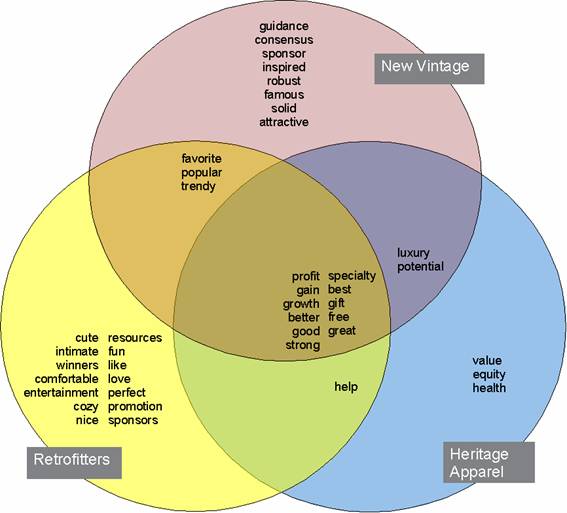
One way to do that is to look at which messages are unique to each company, and which are shared.  Check out this graph – and if it gives you flashbacks to middle school, I’m really sorry. It’s a Venn diagram that looks at the unique and shared positive messages in a media collection describing three retail clothing stores (names have been changed).
 

clip_image002 

You can see right away that the conversations are really quite different. In this conversation, “Heritage Apparel” was the least unique; it has the most generic of the brand identities.  But it also means that “Heritage Apparel’s” identity is similar to the overall competitive landscape.

On the other hand, “Retrofitters” owns the most unique messages. It has a fairly strong brand identity in this conversation. And some of its messages – it was the only one described as “cute,” for example – are really nice to own.

“New Vintage’s” image is different. People are using words like “inspired,” “famous” and “attractive” to describe it. It also is more often described as “favorite,” “popular” and “trendy” than Retrofitters.

 
Here’s another example – one with a more political application.  This Venn shows how different media groups describe controversial Venezuelan president Hugo Chavez.  Rather than comparing him to his competitors (seeing as how he’s president-for-life), it compares the conversations happening in different parts of the world. These are only the negative messages:

  clip_image003


The coverage we get can vary wildly, depending on the perspective of the publication. Hugo Chavez very much embodies this. The entire community agrees on the facts – the study was done in November of 2007 when Chavez advocated for a referendum to allow him to run for president indefinitely, froze diplomatic relations with Columbia, and accused the CIA of orchestrating a coup. 

The Venezuelan media focused on the events in the country.  They acknowledged “criticism,” the “conflict” between Venezuela and Columbia, and a “clash” between pro- and anti- Chavez protestors.  US media used significantly stronger language, with messages like “dictator,” fear” and “suffer.” The non-US International media was considerably more cordial, describing Chavez as “controversial” and saying he was going “too far,” “too fast.” 

When you look at what’s being said (rather than how much is being said) you can position your brand image in a way that is unique and relevant.  Join the discussion: how would you use this data? What would you do if you were each of the clothing retailers? How would you advise Hugo Chavez?

Newspapers: Trend or Term?


In an earlier posting, I opposed the current Public Relations industry panic that “the media is dying.” I maintain that the media is alive and well; it’s evolving. Those of us working in the PR world need to promote that fact that despite cutbacks and right-sizing, the media, including newspapers, is more important than ever.


One way to do this may be to update the definition of terms. Let’s start with the word newspaper.


Most people still see a newspaper as news printed on paper. I submit that even those media outlets that stopped printing and distributing news on paper in favor of an online-only model can still be called newspapers.


We’re already using the word publish with an online meaning. When I’m finished writing this piece, I will hit a button labeled “publish” so you can read it via this blog site. Not many years ago, the word “publish” meant physically producing and disseminating printed pages for public consumption. We’re already far beyond that definition in this digital age. We’ve updated these terms in our lexicon:


  • A file is no longer limited to something in a manila folder
  • To dial-in or dial-up does not require the use of a rotary phone
  • A press kit does not – and should not! – need to be a wasteful and environmentally unfriendly box of junk that PR folks send to journalists who throw them away
  • A record can be a compact disc, not only vinyl
  • An album is a collection of songs, not only on vinyl


Those last two are still hurdles for some people! Let’s all say it together….CDs are records…albums are collections of songs….


Here are a few others to think about. Is “The Office” a Television show? Of course it is, though millions of us do not watch it on a Television but via iTunes, Hulu, DVDs on a laptop, or on a monitor on an airplane.


Are companies like Best Buy or Toys R Us only retail stores, or are they suppliers of goods both digital and physical? I say the latter. I’m a huge Toys R Us customer in my nearly three years of fatherhood, yet I haven’t stepped into a brick & mortar Toys R Us location since I was a kid.


So why are we limiting the term newspaper to exclude digital editions? We need to stop hitting the panic button every time a favorite newspaper or magazine goes online-only and realize that the newspaper lives on. And in the digital world, that means lives on forever.


Social Media Experts or Hammer Gurus?


Self-described Social Media Experts beware!


If you call yourself a social media expert, the rest of us will soon see that you’re saying nothing.


Social media is just…media…channels…tools. It’s a means to deliver your message to your audience. This is true whether you’re a PR person for a coffee shop, a salesperson for an office supply chain, or a fund-raiser for a local charity.
 

Carpenters are carpenters, not Hammer Gurus. Cowboys are cowboys, not rope & fence kings. Drummers are drummers, not drumstick and cymbal experts. Sure, they know a lot about those tools of their trade, but tool expertise alone won’t make get them hired or help their client. The quality of the work they produce with those tools will.


Thanks to Albert Maruggi and Kevin Dugan for listening to my rant earlier this week on this topic! 


Local Media Tips – Guest Blog by Hope Salley

 
This week, my friend Hope Salley of eNR Services is providing a recap local media pitching tips from a PRSA event in Connecticut. The event was hosted by the PRSA -Westchester County and Fairfield County Chapter. The guest speakers were Allan Drury, business reporter/editor with the Journal News (Gannett-Westchester and Rockland Counties), and Jim Zebora, business editor with Hearst CT Newspapers (Connecticut Post, Advocate). Thanks for the tips Hope! – Jack


First and foremost, Allan Drury said that the most important thing a person pitching to the media should do is – do their homework! As quoted by Drury, “Know your reporter. Look at the past six months to see what kind of articles that reporter likes covering. Don’t look at just the past week.” This solidifies why the MatchPoint application is so important to our clients. Drury said it is very important to target the right media.


Below are a few dos and don’ts explained both by Allan Drury and Jim Zebora:


Dos

  • Keep headlines short and concise. Reporters want to see what the news is right away.
  • The best time of day to reach a reporter is in the morning or anytime between noon and 2 p.m. The afternoon hours are usually a “sprint to the finish” time for most reporters and editors.
  • The best way to reach most reporters is via email.
  • After sending a press release, follow up with a phone call to the reporter a few days later.


Don’ts

  • Don’t harass reporters. Continuing to call them or emailing them is a sure turn-off.
  • Don’t send irrelevant stories. Only pitch stories that have merit and offer legitimate news.  

Drury said it is important to include statistical information and research in press releases that offer substantiality to the story. This data backs up the focus of the release, and makes it a lot easier for the journalist (less work they have to do). Drury said press releases without data tend to be “fluffy features.” When it comes to business stories, Zebora conveyed that the reporters at the Hearst CT Newspapers look at mom-and-pop businesses the same as national businesses, meaning small businesses have pertinent, legitimate news just as much as larger corporations. In fact, it is the local businesses – affecting the local community – that journalists are more interested in covering.


Fundamental Change at Media Outlets


Here is a very interesting trend pointed out by the development team at MatchPoint:


PR pros should be aware of a fundamental change in the media. In the current economic debacle, fewer and fewer journalists are employed be a specific media outlet.
 
It appears that the media have responded to the current business conditions, in part, by outsourcing editorial functions. The overwhelming minority of bylined journalists in MatchPoint are staff journalists. Most content is now produced by freelancers and syndicators.
 
For example, an analysis of MatchPoint’s Benton Evening News content, circulation approximately 4,000, produced the following results during a recent sample month:
 

  • 301 bylined articles.
  • 171 unique bylined journalists
  • 30 journalists produced > 5 articles

 
However, the Benton Evening News maintains a staff of only 2!
 
“Contributors,” including both freelancers and syndicators, are rapidly becoming the new mainstream.


For more information on MatchPoint, visit: MatchPoint


Or check out MatchPoint’s Facebook page


Media Outreach via Twitter


In March 2008, the Dow was over 12,000 and just a handful of early-adapting journalists and PR folks were using Twitter on a regular basis. What a difference 12 months make! The growth of Twitter has created an amazing and somewhat frightening channel to PR pro’s to converse with the media.


I would like to hear your stories and comments about experiences connecting with journalists in recent months.


  • How has your media outreach via Twitter been received?


  • Any negative feedback from journalists?


  • Overall, has Tweeting journalists been effective for you?


  • What would help improve this method of engagement?


Please comment below or send your tales to me at jmonson@enr-corp.com


Tips for Driving Business via Local PR from Webinar


On Tuesday, February 10th, I had the pleasure of moderating a webinar discussing “How to Drive Business Though Local PR.”


Our participants, Nicole Rivard, Editor of the Norwalk Citizen-News and Matt Gentile, Director of PR and Brand Communications at Century 21, offered tips from both sides of the news release for successfully reaching targeted audiences in community publications.


Nicole Rivard first discussed the types of stories of most interest to an editor at a weekly community newspaper. These included news about local companies (or more likely, national brands with local branches, outlets, or franchisees) with the following content:


  • Giving back to the community
  • Participating with local schools
  • Opening a new business, location
  • Reaching a milestone
  • Growing the business


Matt Gentile spoke about Century 21’s efforts in reaching consumers and potential franchisees via news on the local level. Some of the most successful releases have positioned local agents and brokers as industry experts to whom the local media can turn for trend-related stories.


Century 21 not only targets various local markets from corporate headquarters, but also empowers regional offices and up to 4,000 brokers with a tool to easily and quickly send press releases to their own local media. The application they use, PR Studio, was developed by Grassroots PR.


Here is an overview of things to remember when pitching local media:


ü ONLY pitch stories that have a true local connection, such as a physical presence in the market, connection to a local businessperson, or event taking place


ü READ content from the publication prior to engaging to see if your story is a good fit for what is happening locally
 

ü BE AWARE of deadlines and printing schedules for weekly publications


ü EMAIL releases directly to journalists as opposed to relying on wires, social media, or other methods better suited toward national outreach


MatchPoint Launches

We’ve all played the target & hope game of using a media database:
1. Target journalist in database

2. Hope he or she still works at that outlet, covers that same beat, and has any interest in your topic


This week, MatchPoint is changing the game. MatchPoint is offering a 10 Day Free Trial to check out this innovative new way to match your press release or other pitching materials with relevant journalists and bloggers.


Here’s a link to the free trial sign-up:


http://www.prmatchpoint.com/register.asp