
Apple and Apple PR

 
apple-logoApple-logo9
 

 The Biggest Release That Wasn’t Released…Yet


Many Beatles and iTunes fans spent the past few weeks speculating that The Beatles catalog would debut on iTunes at the same time as the remastering of their catalog on CD and the debut of Beatles Rock Band, making a perfect hat trick. Many in the PR community also anticipated this cross-promotion no-brainer.

However, the lack of an iTunes announcement on 09.09.09 made the Apple gathering a non-event for some. But just wait…the delay will create yet another publicity-friendly event in the future. And, even more important to Apple Inc and Apple Records, a future Beatles / iTunes event will ultimately drive more sales via more product downloads.  Steve Jobs even said, “we’ll see you soon.”

This masterful delay didn’t waste a great event and allow the iTunes availability to get buried in the PR and ad frenzy of Beatles CDs and Rock Band by Apple Records or the new iPod launches, iTunes 9 update, and the return of Mr. Jobs by Apple Corp.

After all, September is the time for releasing holiday gift choices (CDs, video games, and new iPods) not downloadable songs which won’t really drive holiday sales. It’s very smart of the two Apples to delay a deal and announcement until 2010 or later.


A Brief History of Beatles Repackaging 
 
The 2009 remastering project is not the first time the band’s records have been repackaged and sold amid a flurry of positive PR and fan response. If you were born post-Beatlemania, chances are your first Beatles record was not Meet The Beatles or Sgt Pepper’s, but was one of these previous top-selling collections:

2006 Love200px-LOVE

Love is a remixing, editing and splicing of a hundred or so Beatles tunes mashed together as a soundtrack for Circe du Soleil. It sounds like blasphemy to purists, but being produced by Sir George Martin makes it not only legitimate but fun to hear. I think the platinum-selling Love was also was a test for the 2009 remastering project.


2006 Capitol YearsBeatlesCapitolAlbumsVol1albumcover
200px-BeatlesCapitolAlbumsVol2albumcoverThis remixing of the first 8 US Capitol Beatles albums was the first time some of the US versions of Beatles records made it to CD.


2000 The Beatles 1200px-The_Beatles_1_album_cover
This is virtually the same set of tracks as 1982’s “20 Greatest” released on CD and promoted to the next generation of fans. The result: over 10 million copies sold in the US alone!


1995-96 Anthology 1, 2, & 3

200px-Anthology1coverNot truly a greatest hits compilation; the Anthology series featured alternate versions, demos, outtakes, and historical live performances. It also served as a companion piece to the much-hyped ABC documentary series of the same name. The Apple and Capitol promotional machine did phenomenal job making sure every person on in America knew about this release


1988 Past Masters Volume 1 & 2
1988 Beatles Box Set200px-Past_mastersbeatles
This release was significant as the first complete box set of all albums on CDs plus the two Past Masters CDs of singles and B-sides not available on any album. This set is virtually identical to the 2009 release but not remastered.


1982 20 Greatest Hits200px-20GreatestHitsalbumcover

Absolutely nothing special about this release – just repackaging the same ol’ songs and selling millions of copies to a new generation of fans, that’s all.


1982 Reel Music200px-ReelMusicalbumcoverfront

In the 70’s and 80’s, Capitol seemed to like to have a twist or theme to tracks repackaged and compiled. I guess this gave consumers a reason to care. This one featured only music from the Beatles movies (???). This also featured a “new” track: a medley of the Beatles movie songs taking advantage of the Stars on 45 fad happening at the time.


1977 Love Songs200px-TheBeatlesLoveSongsalbumcover

The repackaging theme for this compilation was obviously the band’s love songs and ballads.


1976 Rock ‘n’ Roll Music200px-BeatlesRockNRollMusicalbumcover
The repackaging theme for this inferior compilation was old-time rock n rolls cover tunes written by Chuck Berry and others. I assume the thought behind this choice was the fact that these cover tunes were not included in the 1973 Red and Blue albums below, even though “Twist & Shout” and others were some the band’s most popular early records. These tracks were poorly selected and remixed and the packaging looked substandard. It’s interesting that this compilation itself was repackaged four years later and split into two budget-priced albums.


 1973 The Beatles 1962-1966 (aka “The Red Album”)200px-Beatles19621966


These are the granddaddy of all compilations, great hits, and repackaging! These mega-selling albums were #1 worldwide instantly and sold well for the next two decades.


1973 The Beatles 1967-1970 (aka “The Blue Album”)200px-Beatles19671970



1970 Hey Jude200px-Heyjudealbum
At the time, Apple and Capitol tried to spin this release as a new Beatles album (in the US only). But the only thing new was the packaging. All tracks were previously released as singles or b-sides, but never included on previous Beatles albums. The plan worked, with the record reaching #2 on the US album charts.

Death of PR Spam

PR Spam took a few more hits last week. First, blogger Gina Trapani created a new wiki of PR agencies who have spammed her via press release. 
 
Secondly, MatchPoint rolled out a new version: MatchPoint v1.5. The anti-PR Spam tool will keep users off of Gina’s list!
 
 PR Spam
 
PR Spammers (and the over-priced PR vendors who enable them!) typically build lists of journalists (based on beats) who may or may not have ever written an article or blog related to the Spammers’ blast press release.
  
MatchPoint allows PR pros to identify the most appropriate reporters and bloggers based on what they have recently written, not by outdated information like beat or title.
 
The true PR Spam killer is this: after finding an appropriate journalist, users can engage them one-on-one directly through MatchPoint. The personalized, custom message can range from a simple pitch note to a full multi-media press package.
 
Other new enhancements include the ability for PR pros to monitor specific journalists, create notes on follow up activity, and evaluate success of campaigns with detailed tracking reports.
 
MatchPoint is now giving journalists the ability to evaluate the usefulness of story pitches and rank the sender. This new system was designed to weed out PR Spammers and open a dialogue between professional PR practitioners and journalists.
 
PR professionals can get a free ten-day trial at this link. PR Spammers should ignore this link!

Social Media Experts or Hammer Gurus? Part 2

In an earlier post, I discussed the continuing sensation of some communications folks appointing themselves “social media experts.” Once again if you are calling yourself this, I implore you to stop! You’re saying nothing!
 
Social media is a tool; you need to be an expert in the messages you’re crafting.

A good carpenter knows more than just the inner-workings of a hammer and is therefore more than a hammer guru.
 
There are hundreds of twitter users who list in their bio that they are social media experts, gurus, kings, queens, and mavens. Uggggg!
 
fail 
I’m not sure what credentials one needs to make this claim. Did they discover LinkedIn two days before the rest of the world? Do they have more time to spend on Facebook lately since their PR agency business has slowed down?
  
One of my local PR community’s favorite butt of many jokes is one such self-described “mavens.” My favorite part of this story is that this CEO joined Twitter only after hearing about it on Oprah this past spring. You can’t put lipstick on an outdated publicity model and call it a social media consultancy.
 
Here’s another gem. I recently started following on Twitter a marketing and PR agency that says it specializes in social media strategy. What happened next? You guessed it…I received a generic auto-DM saying “thanks for the follow.” I hope they are not charging their clients actual money for their social media expertise.
 
Don’t misunderstand – there are many true social media experts out there. The best of them do not need to call themselves experts; their clients and peers are doing that for them.

Media Measurement: Focusing on What’s Being Said


This week’s PR Workbench post is by guest bloggers Brad Snyder and Maddie Forrester of Perception Metrics. Perception Metrics delivers data-driven media insight quickly and cost effectively to brand managers, public relations professionals, and their clients.


Looking at what’s being said, not just who is saying it (how many times)

When people talk about media analysis, they’re normally discussing results measurement – figuring out what impact they’ve have had and proving it to their clients.

But considering the amount of time and resources that go into creating a brand identity, there is surprisingly little listening done in advance, before brand books are signed, sealed and delivered. 

Imagine, for example, that you are at your local pub and you overhear people talking about your company and its competitors. Without a doubt, you’d be most interested in what was being said, not just who was doing the talking or how many times they mentioned each product or competitor. You might also notice their overall tone, of course, or how much of the conversation was focused on which company, but you (and your boss) probably want to know how, in this conversation, each brand is described.

The same principle should be applied to media analysis. So much of our industry focuses on “how good” the conversation is, overall, or “how much” of it there is. But media analysis can also delve into what, exactly, is being said. That can help you clarify errors, affirm and repeat positives, and share your perspective. You can also compare the ways that your company’s perception (what people think it is) is different from its projection (what you are saying it is)…and hopefully, you would use this information to make decisions about how your organization should act next.

When the conversation you’re “overhearing” is actually the sum total of newspapers, blogs, message boards, Twitter, and the TV – well, you have to boil it down quite a bit to understand what’s going on.

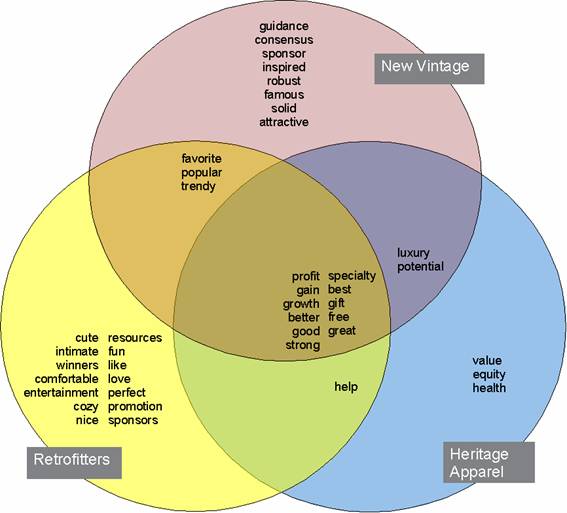
One way to do that is to look at which messages are unique to each company, and which are shared.  Check out this graph – and if it gives you flashbacks to middle school, I’m really sorry. It’s a Venn diagram that looks at the unique and shared positive messages in a media collection describing three retail clothing stores (names have been changed).
 

clip_image002 

You can see right away that the conversations are really quite different. In this conversation, “Heritage Apparel” was the least unique; it has the most generic of the brand identities.  But it also means that “Heritage Apparel’s” identity is similar to the overall competitive landscape.

On the other hand, “Retrofitters” owns the most unique messages. It has a fairly strong brand identity in this conversation. And some of its messages – it was the only one described as “cute,” for example – are really nice to own.

“New Vintage’s” image is different. People are using words like “inspired,” “famous” and “attractive” to describe it. It also is more often described as “favorite,” “popular” and “trendy” than Retrofitters.

 
Here’s another example – one with a more political application.  This Venn shows how different media groups describe controversial Venezuelan president Hugo Chavez.  Rather than comparing him to his competitors (seeing as how he’s president-for-life), it compares the conversations happening in different parts of the world. These are only the negative messages:

  clip_image003


The coverage we get can vary wildly, depending on the perspective of the publication. Hugo Chavez very much embodies this. The entire community agrees on the facts – the study was done in November of 2007 when Chavez advocated for a referendum to allow him to run for president indefinitely, froze diplomatic relations with Columbia, and accused the CIA of orchestrating a coup. 

The Venezuelan media focused on the events in the country.  They acknowledged “criticism,” the “conflict” between Venezuela and Columbia, and a “clash” between pro- and anti- Chavez protestors.  US media used significantly stronger language, with messages like “dictator,” fear” and “suffer.” The non-US International media was considerably more cordial, describing Chavez as “controversial” and saying he was going “too far,” “too fast.” 

When you look at what’s being said (rather than how much is being said) you can position your brand image in a way that is unique and relevant.  Join the discussion: how would you use this data? What would you do if you were each of the clothing retailers? How would you advise Hugo Chavez?

Bulldog Media Relations Summit – Update

 
Yesterday, our team at eNR had a lively discussion on the direction of social media and public relations lead by co-developer of our MatchPoint service, Peter Himler of Flatiron Communications.
 
For anyone attending the Media Relations Summit in New York this weekend through Tuesday, Peter has organized a Tweetup on Monday. Click here for details and registration: http://nyctweet.eventbrite.com/


Crown Plaza Times Square - Home of Media Relations Summit 09


Bulldog Media Relations Summit 2009 – Prologue

 
Media Relations pro’s – are you heading to the Bulldog Media Relations conference in New York this weekend? Why not?
  
This year’s show has tremendous potential with keynote speakers such as news icon Dan Rather and popular anchor / consultant Dan Abrams. 
  mr09logo
Please check back here throughout the weekend and week as we’ll be posting updates, photos, Tweetup details, and commentary.
  
 What are you looking forward to seeing at this year’s show?

PRWeek Goes Monthly


PRWeek has just announced that that it will soon be a monthly magazine. This was part of a slew of announcements about revamps of the online edition, e-newsletter, and blogs.prweeklogo1


See the full announcement here:
 

http://www.prweekus.com/PRWeek-announces-weekly-online-edition/article/130669/

 
This move makes sense to me, especially combined with the online changes and additions. 

 
What are your thoughts on PRWeek and other PR industry publications? Are they still near the top of your reading stack? Or have you already seen most of the content online by the time it arrives? 

Social Media Experts or Hammer Gurus?


Self-described Social Media Experts beware!


If you call yourself a social media expert, the rest of us will soon see that you’re saying nothing.


Social media is just…media…channels…tools. It’s a means to deliver your message to your audience. This is true whether you’re a PR person for a coffee shop, a salesperson for an office supply chain, or a fund-raiser for a local charity.
 

Carpenters are carpenters, not Hammer Gurus. Cowboys are cowboys, not rope & fence kings. Drummers are drummers, not drumstick and cymbal experts. Sure, they know a lot about those tools of their trade, but tool expertise alone won’t make get them hired or help their client. The quality of the work they produce with those tools will.


Thanks to Albert Maruggi and Kevin Dugan for listening to my rant earlier this week on this topic! 


Local Media Tips – Guest Blog by Hope Salley

 
This week, my friend Hope Salley of eNR Services is providing a recap local media pitching tips from a PRSA event in Connecticut. The event was hosted by the PRSA -Westchester County and Fairfield County Chapter. The guest speakers were Allan Drury, business reporter/editor with the Journal News (Gannett-Westchester and Rockland Counties), and Jim Zebora, business editor with Hearst CT Newspapers (Connecticut Post, Advocate). Thanks for the tips Hope! – Jack


First and foremost, Allan Drury said that the most important thing a person pitching to the media should do is – do their homework! As quoted by Drury, “Know your reporter. Look at the past six months to see what kind of articles that reporter likes covering. Don’t look at just the past week.” This solidifies why the MatchPoint application is so important to our clients. Drury said it is very important to target the right media.


Below are a few dos and don’ts explained both by Allan Drury and Jim Zebora:


Dos

  • Keep headlines short and concise. Reporters want to see what the news is right away.
  • The best time of day to reach a reporter is in the morning or anytime between noon and 2 p.m. The afternoon hours are usually a “sprint to the finish” time for most reporters and editors.
  • The best way to reach most reporters is via email.
  • After sending a press release, follow up with a phone call to the reporter a few days later.


Don’ts

  • Don’t harass reporters. Continuing to call them or emailing them is a sure turn-off.
  • Don’t send irrelevant stories. Only pitch stories that have merit and offer legitimate news.  

Drury said it is important to include statistical information and research in press releases that offer substantiality to the story. This data backs up the focus of the release, and makes it a lot easier for the journalist (less work they have to do). Drury said press releases without data tend to be “fluffy features.” When it comes to business stories, Zebora conveyed that the reporters at the Hearst CT Newspapers look at mom-and-pop businesses the same as national businesses, meaning small businesses have pertinent, legitimate news just as much as larger corporations. In fact, it is the local businesses – affecting the local community – that journalists are more interested in covering.


Is PR Recession-Proof? A farm boy asks…

For horse owners, spring means expanding your network of resources to hay suppliers, stables, and farmers who still have hay stocked up and are willing to part with it. Last Saturday, we were fortunate enough to find a farmer in Northern Illinois with plenty to sell. The guy’s son would even help load the truck.

Profit, the horse who sparked the conversation


As we were loading bails of hay, the kid asked me if I worked with horses for a living. “No,” I said, “just one day a week, I guess. On the other six days, I’m in public relations in Chicago.”
 
I had expected the typical questions like “What does that mean?” or “Do you know anyone famous?” Instead he asked, “Is public relations recession-proof?”


This shocked me. Why was that his first and only question about PR? He was thinking about career choices and the most important thing to him is an industry’s position in the current economic climate. The source of this thought could have been TV network and cable news. But wait, this was a high school guy and they don’t watch TV news. My conclusion is that on whatever social media sites this kid tapped in to, the recession is being discussed along with PS3 games.


I gave him my standard answer: “Is anything really recession-proof?” He answered, “Yeah, I guess not, except for certain aspects of the entertainment industry and the mob.” Okay, so this kid knows his Sopranos quotes too.
 

I told him “despite the recession, we’re doing all right. In fact, it’s going to be a great year for PR. More companies will need to use PR to get their messages to consumers. When they see the costs of PR and the results they get compared to advertising, it’s a no-brainer.”


He seemed to get it! He even asked more about the return on investment of PR versus traditional advertising! Maybe this kid will be interested in a PR career. Though he might want to consider following his Dad into the hay business…demand is high, prices are up 25% over last year, and no one is Tweeting about lay-offs.