Stop Targeting Millennials Like Zombies

zombie-499924_1280

Is there anything more ridiculous to Millennials than the phrase “Marketing to Millennials?”

It seems the entire consumer marketing machine in the US has done the math, and has targeted Millennials as the key to selling anything. Marketers struggle with how to easily reach this massive crowd. I’m still struggling with spelling Millennials without the use of auto-correct.


But, Just who is “They?”

We see many criticisms of Millennials saying, “They are… “ or “They don’t…”

There are 80 million people in the US that fall into this age group. A cookie-cutter approach to marketing to or communicating with any group of 80 million people is doomed! I’m not sure how you stereotype 80 million people as having the same characteristics, nature, and experiences.

“Advertisers say, ‘we want Millennial Moms!’ Well, which Millennial Moms do you want?”
– Bob Pittman, CEO of iHeartMedia, and broadcasting legend, at Media Tech Summit 2015.

Why does this happen? It’s just easier

Aging Baby Boomers and some still-clueless Gen X’ers may find it easier to just paint all 80 million Millennials with the same brush. We talk about them like they are interchangeable zombies in an old film. “Yeah, one rifle bullet will get ‘er done.”

If we paint all of the Millennials with the same bush, we will sell them short, as well as our own businesses and services.

Don’t be lazy

Millennials are now up to 33 years old. They’re not all young kids any more. John Bonham, Keith Moon, and Jesus were all younger than many Millennials are now. Within those 33 years, it’s likely 80 Million people developed more than one style, taste, or preference for communications. Drill down to find multiple ways to communicate with a large group of people with diverse interests, preferences, and lifestyles.



Is Twitter a Place to Engage Anymore?

Twitter woman

Search or Social?

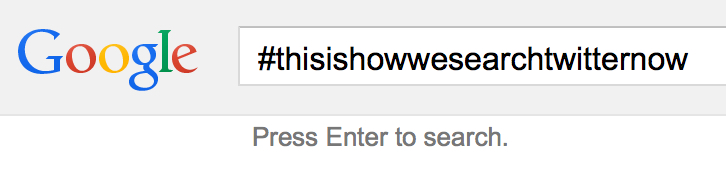
Google’s inclusion of Twitter in search results continues to expand. Last week Tweets began appearing in the Google search results for desktop users in the UK.

The reality is that Twitter is already primarily a search engine. It searches a massive link library that also happens to be called Twitter. This library now also holds images and videos. Faster access to this library will eventually be available to everyone via Google.

This will lead to an increase of importance of your Tweets, and a decrease in the need to ever go to Twitter.


tweetsearchshot copy


Social Engagement (or Lack of…)

What about engagement with your loyal followers? And those who you follow? Let’s face it – no one is really following those they follow. People and brands pay attention to mentions of their own name or brand.

Outside self-monitoring, content on Twitter is only consumed when a user runs a search, either by using the search box or clicking on a hashtag. Tweets will soon be consumed mostly by those who are no longer even on Twitter, but Google instead.

 .

Who you follow: does not matter at all

Who follows you: does not matter at all

Your Tweets being seen in search results: ALL THAT MATTERS

 .

There is something genuine and sensible about this. It doesn’t matter how many followers you acquire. If you don’t post anything of interest, no one will see it! If your brand is not Tweeting a constant cadence of quality content, you’re going to miss out on opportunities to be found via Google.

What’s next? If Google is replacing Twitter.com as the place to see Tweets, could Twitter replace Google+ as Google’s real-time publishing area?

.

.

Content Marketing and Traditional News

cloud-709095_1920   Facebook’s latest changes to users’ News Feeds means it is more important than ever to create interesting, relevant content that your brand’s fans will want to share with their friends. Let’s add a layer to that share-friendly content strategy: News Outlets. Here’s an example using The Des Moines Register, a news outlet that will be in the global spotlight again due to the upcoming caucuses. A brand or small business may get its story told (placed) not only in the Des Moines Register print version and website, but also via a post on the Register’s Facebook page. And now, most importantly, in the Facebook News Feed of the Des Moines Register’s Facebook Fans who may then also share it! We used to think it was great to get a story placed on a newspaper’s website because the story could be found via search. Getting shared is better. A few recent observations:

  • All media outlets, especially those from smaller markets are posting less hard news content and more human interest, lifestyle, and fun stuff on their Facebook pages for the same reason we do for our clients: it gets noticed and shared.
  • Facebook’s algorithm favors what it deems to be news outlets even if they are just sharing that fun stuff and not hard news.
  • The most shared content on all of Facebook last month came from The Huffington Post. You can argue if this is a credible news site, a biased blog, a tabloid, or all of the above. But Facebook’s favoring has made it a golden opportunity.  

Calling all PR professionals – your services are needed! As more brands jump into content marketing, reaching traditional media outlets that have a great social following needs to be part of the content marketing strategy.   

Hope Is Not a Content Marketing Strategy

star-833988_1920


Facebook has made a big change that allows users to choose which friends’ or pages’ posts they can “See First” in their News Feeds.

We’re already seeing some pages asking, suggesting, and begging consumers to click on the More button and then click See First to move new posts to the top of their News Feed.

This is after spending the last 6 years asking, suggesting, and begging consumers to click the Like button.

This is not a Strategy; it’s a Hope.

Don’t waste the limited time, space, and attention fans are giving by you asking them to go click something that is not going matter to them and won’t matter much to you in the long run. A few fans may do this, but why would most fans bother? What’s in it for them?


Pages are scrambling to get you to "See First" or "Star" ... this is not a strategy.
Pages are scrambling to get you to “See First” or “Star”          This is not a Strategy; it’s a Hope.


Instead, let’s use the other part of Facebook’s new change to our advantage. The ability for consumers to see their most influential friends’ posts first is exciting and creates interesting opportunities.

Focus your resources on creating the best possible content. Then boost those posts to maximize exposure. If this content is relevant and interesting, you can count on those viewers to share it with their friends.

Users will see your content shared by their friends instead of more noise from other brands’ pages including your competitors’ pages!


The Strategy:

Create good content that is more likely to be shared.


The Tactics:

  1. Post content relevant to your audience (this is nothing new…)
  2. Boost it
  3. If it’s good, it gets shared by your fans or targeted audience to their friends


Again, you’re not gaming a system by begging for “Stars” or “See Firsts”; you’re providing good content that fans with share with their friends. That is always a good idea and it’s a winning strategy.


Facebook Content Marketing in 4 Steps

fRANCHISING

The most important place for your brand’s content marketing is likely Facebook. For franchise brands, here are the four steps to effectively tell your story to customers.

Three of these are controlled by the franchisor; the fourth and final step is in the hands of each franchisee.

  
Steps 1, 2, & 3 by the Franchisor:

1. The Franchisor Takes Control of brand on all social pages
Don’t drive consumers to your franchisees’ pages until they’re ready. Be confident that they are all up to date with current logos, images, names, and proper content.

2. The Franchisor Publishes organic content, curated news, great stories
Share valuable content to all franchisee pages for their local fans to consume.

3. The Franchisor Sets up Franchisees to Engage
This may be empowerment for some systems that set up franchisees to dive in.  Or this may be more controlled for some systems that want to approve content from franchisees before it goes out live.


Step 4 by the Franchisee:

4. The Franchisee Boosts Some of the Above Posts on Facebook
This will maximize local audience exposure at the local unit’s discretion and depending on its means. Instead of spending resources on creating content, the franchisee can efficiently choose some of the posts the franchisor published (in Step 2) and boost with local ad dollars. Boosting will vary based on the franchisee’s budget.

Need more info publishing to franchisees’ pages? Connect with my colleagues at Manalto to learn more.


Advice From Your Social Media Consigliere

When debating what is the greatest film of all time, the only question for me is “Part 1 or Part 2?”

Of course I refer to The Godfather. In both part 1 and part 2, the Consigliere had an important role in mapping out plans for the future and giving advice (some taken, some not) for the next move.

12.-Tom

I have written on this blog many times about my dislike of terms like Social Media Expert, Guru, Ninja, and Maven. But lately I like Consigliere: a trusted advisor to the Boss.

As your unofficial Consigliere, I can tell you this: In social media marketing right now there are too many Fredos and not enough Michaels.

FredoCorleone1. Don’t be a Fredo

Be bold, be strong, and be smart.  You may have a good heart but that will still get you passed over. Most importantly, never take sides against the organization.


Sonny corleone_22. But don’t be a Sonny either

Saying what you think at the wrong time may result in tragedy for your boss and your hotheaded carelessness will lead to your own demise.


Michaelcoreleone3. Be a Michael, to a point

Be fearless and innovative, yet patient enough to act at the perfect time. But when you want to get out of a bad situation, don’t let them pull you back in!


Social Geek Tip for Next Week: Share 2 Pieces of Curated Content Per Day

social-media- blocks


If you want to quickly build your brand’s fanbase, there’s no easier way than to share some relevant, interesting content from a news source, blog, or other page. Starting next week, commit to sharing at least 2 posts per day on Facebook, Twitter, LinkedIn, and any of your other social assets.

3 would be better…4 would be even better!

In The Art of Social Media, Guy Kawasaki and Peg Fitzpatrick recommend 4 posts per day on Facebook and a whooping 25 per day (!) on Twitter just to rise above the noise. But, if you still think you’re too busy right now, at least get the ball rolling with a commitment of 2 shares per day of cured content. And then when you see good results, keep going! 


Podcasting as Content Marketing


Franchising World Cover

 
Here’s my recent article in Franchising World magazine exploring the Podcast as a form of Content Marketing. Included are the benefits of podcasting, some tips to get started, and a program guide for some of my favorite industry podcasts.