Is Facebook Replacing the Internet?

facebook-388078_1920

Facebook. It’s where your customers are.

Just a couple of years ago, many digital marketers frequently forecasted the end of Facebook:

It surely won’t dominate for long. There must be some Facebook killer out there. Be platform agnostic – don’t build your business only on Facebook.

But now, unless your customers are a small niche group, they are on Facebook and spending more time on Facebook than ever!

Sure, there’s also still great value in Twitter, Instagram, LinkedIn, and … well, I guess just Twitter, Instagram, and LinkedIn. Snapchat, Pinterest, and the rest all have their place, and are great for some brands and audiences, but not all.

Play the numbers. Your customers are on Facebook and spending less time on the non-Facebook portion of the Internet. And that portion may be replaced or eaten by Facebook. Here are some parts of your digital world that may soon be replaced by Facebook and a next step for each to help you prepare.

1. Facebook Replacing Your Company Website

Some consumers already won’t leave the “Friendly Confines” of Facebook. In the months and years ahead, fewer of them will be likely to leave and go to some corporate website.

If your digital marketing strategy only focuses on driving people from Facebook to your website, consider skipping this step and engaging that audience while they have given you some attention.

What activity can customers do on your website that grows your business? Ordering product / eCommerce? Making appointments? Downloading videos? Do that same thing on your Facebook page.

Next Step: Look at your website and replicate the business-driving activity.

2. Facebook Video Replacing of YouTube As a Social Video Channel

Facebook is taking a big bite out of YouTube’s video ad business. At the same time, we should look at the current state of using these platforms to share organic video content.

YouTube is amazing, but it’s a repository, not a social channel. Sure, continue to upload all of your videos there for consumers to find through YouTube / Google searches, but don’t drive your Facebook fans there. Where would you prefer customers spend a few extra minutes? On your Facebook page where they can engage and communicate with you or on your YouTube channel, which lends itself more to snark from trolls than genuine customer engagement?

Next Step: Start posting your original video content direct to Facebook, not links from YouTube.

3. Facebook Ads Replacing Online Ads

The Ad Blocking trend is a HUGE opportunity for your brand on Facebook.

Ad blocking tools block nearly all types of mobile ads. But what’s not stopped? Facebook boosted posts (as well as Twitter promoted Tweets and other social ads).

Steve Rubel of Edelman recently wrote that this situation will make earned media more valuable and I absolutely agree. The way to best draw new customers to your brand is with interesting and relevant content. And the best way to attract consumers to that content in the first place is by paid ads on social channels.

Next Step: Jump into Facebook ads, particularly boosted posts now.

What other parts of the Internet do you think may soon be eaten by Facebook?

Please share in the comments section below. We’ll continue this discussion on this week’s episode of Social Geek Radio with my guest digital strategist and author, Chris Adams!

Pumpkin Spice Marketing

IMG_1310


Add one of these phrases or adjectives to any post about your product or service and I will bet that you’ll increase interest and attention by 50%:


  1. Pumpkin Spice
  2. Big Data
  3. Content Marketing
  4. Cage-free
  5. Craft
  6. Organic
  7. Sea Salt
  8. Engagement
  9. Sriracha

Okay, I’m half kidding, but it seems to work. Where you take it after getting that attention is another story!

Franchise Sales Using Facebook

fRANCHISING

How much of your brand’s Facebook activity should be devoted to franchise sales efforts versus consumer marketing and engagement?
 
Many franchise systems with whom I’ve spoken in the past several years have struggled with balancing their social media communication for consumers and their engagement with potential franchisees. Some designate a certain amount of content on the page for consumer marketing and an amount for franchise development. Others create completely separate Facebook pages for their franchise sales messages.

I don’t recommend either of these practices; all goals of marketing a franchise on Facebook can be achieved in a more holistic approach.


Your Page Versus Their Feed

First, let’s stop thinking of Facebook pages like websites with certain amount of real estate devoted to various parts of your organization. A Facebook page is really just your starting point.

The true power of Facebook communication lies in users seeing your brand and your news on his or her news feed, not on your Facebook page.

It doesn’t really matter what’s on your page. Very few people are ever going to seek out your page and view it the way people once did with websites. Typical consumers won’t be confused by your franchise sales messages because they don’t see them.


Organic Versus Paid Target

Your messages may be seen as organic (free) posts, which will reach 2% to 20% of your fans, depending on your fanbase size. But more likely, your messages will be seen in the form of boosted posts or other types of paid advertising. The reach or size of audience depends how many dollars you want to spend.

Target your paid content by the demographics of your franchise sales candidates. This goes beyond just age and gender; target according to your typical candidates’ interests, industries, and more.

Even within your group of franchise sales posts, you may want to change up content or demographics based on location. Messages promoted to Texas candidates might need to be different than those promoted to Florida candidates.

Your brand’s fans and your franchisees’ customers won’t see that content. With a few exceptions, I typically don’t see anything wrong with showing consumers some franchise sales-specific social media content. But when paying to boost and target Facebook posts, it is cost prohibitive to show all messages to all people.


Stop Targeting Millennials Like Zombies

zombie-499924_1280

Is there anything more ridiculous to Millennials than the phrase “Marketing to Millennials?”

It seems the entire consumer marketing machine in the US has done the math, and has targeted Millennials as the key to selling anything. Marketers struggle with how to easily reach this massive crowd. I’m still struggling with spelling Millennials without the use of auto-correct.


But, Just who is “They?”

We see many criticisms of Millennials saying, “They are… “ or “They don’t…”

There are 80 million people in the US that fall into this age group. A cookie-cutter approach to marketing to or communicating with any group of 80 million people is doomed! I’m not sure how you stereotype 80 million people as having the same characteristics, nature, and experiences.

“Advertisers say, ‘we want Millennial Moms!’ Well, which Millennial Moms do you want?”
– Bob Pittman, CEO of iHeartMedia, and broadcasting legend, at Media Tech Summit 2015.

Why does this happen? It’s just easier

Aging Baby Boomers and some still-clueless Gen X’ers may find it easier to just paint all 80 million Millennials with the same brush. We talk about them like they are interchangeable zombies in an old film. “Yeah, one rifle bullet will get ‘er done.”

If we paint all of the Millennials with the same bush, we will sell them short, as well as our own businesses and services.

Don’t be lazy

Millennials are now up to 33 years old. They’re not all young kids any more. John Bonham, Keith Moon, and Jesus were all younger than many Millennials are now. Within those 33 years, it’s likely 80 Million people developed more than one style, taste, or preference for communications. Drill down to find multiple ways to communicate with a large group of people with diverse interests, preferences, and lifestyles.


Small Businesses, Mega-Brands, and Hope.

full-moon-873437_1280

Defending Small Businesses on Capitol Hill

This month will end with members of the International Franchise Association once again gathering in Washington DC and meeting with legislators. We will discuss several issues affecting all franchisors, franchisees, and suppliers as well as lobby for less regulatory impediments as usual.

The key issue this year will be the National Labor Relations Board’s decision to completely ignore the basis of the franchise business model. The NLRB recently ruled that some businesses are now responsible for the employment actions of other businesses.

Unless you’re blissfully ignorant or work for a service union, you will agree that employees of a locally owned business are NOT actually employed by a corporation that had nothing to do with hiring those employees. (Without setting foot on Capitol Hill, I can tell you right now how the two senators from my home state of Illinois will respond.)

If the work of the IFA in past years is any indication, the IFA members and the IFA team will do a fantastic job of communicating the needs for running a business, growing that business, creating jobs, and ultimately growing the economy.

Mega-Brands and “Hope”

But how much of this effort pays off for those who do most of the heavy lifting – small to medium sized franchise systems – versus the huge brands? Will McDonalds and the other mega-sized franchises join this fight? If we’re successful, these large brands have the most to gain. Will they support this activity and join us on Capitol Hill? I hope so.

A great deal of pro-business promotion, communication, and lobbying is done by franchise industry suppliers. Are the mega-brands supporting these suppliers? I hope so.

When they select a PR firm, software vendor, ad agency, insurance provider, or other business service, do they ask if that supplier supports franchising and the IFA? I hope so.

Continuing to educate legislators and voters about how businesses operate is important for the IFA this year. Perhaps in 2016, we can also educate some large brands about how businesses operate.

Is Twitter a Place to Engage Anymore?

Twitter woman

Search or Social?

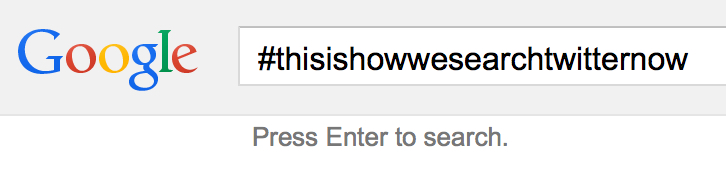
Google’s inclusion of Twitter in search results continues to expand. Last week Tweets began appearing in the Google search results for desktop users in the UK.

The reality is that Twitter is already primarily a search engine. It searches a massive link library that also happens to be called Twitter. This library now also holds images and videos. Faster access to this library will eventually be available to everyone via Google.

This will lead to an increase of importance of your Tweets, and a decrease in the need to ever go to Twitter.


tweetsearchshot copy


Social Engagement (or Lack of…)

What about engagement with your loyal followers? And those who you follow? Let’s face it – no one is really following those they follow. People and brands pay attention to mentions of their own name or brand.

Outside self-monitoring, content on Twitter is only consumed when a user runs a search, either by using the search box or clicking on a hashtag. Tweets will soon be consumed mostly by those who are no longer even on Twitter, but Google instead.

 .

Who you follow: does not matter at all

Who follows you: does not matter at all

Your Tweets being seen in search results: ALL THAT MATTERS

 .

There is something genuine and sensible about this. It doesn’t matter how many followers you acquire. If you don’t post anything of interest, no one will see it! If your brand is not Tweeting a constant cadence of quality content, you’re going to miss out on opportunities to be found via Google.

What’s next? If Google is replacing Twitter.com as the place to see Tweets, could Twitter replace Google+ as Google’s real-time publishing area?

.

.

Why You Don’t Want 1 Million Likes on Facebook

facebook-715811_1920


You DON’T want 1 Million Likes on Facebook.

You want 100 pages with 10,000 likes. Or 1,000 pages with 1,000 likes!


Many digital marketers have spent the past year spreading the news that Facebook posts are organically reaching a mere 1% or 2% of their fans’ newsfeeds.

While this may be the case for huge brands with millions of fans, there’s good news for midsize brands. Earlier this year Locowise reported the following average organic post reach for Facebook pages of these sizes:

1 Million+ Likes                     2.27%

500,000 Likes                       7.47%

50,000 Likes                         9.62%

Under 1,000 Likes              14.21%


Sure, you would rather reach 2% of One Million people than 14% of One Thousand people. But what if you could repeat that 14% over another 1,000 pages? 

Who has that potential and could benefit in this current situation? Franchises!  Why? Because they don’t just have one small page with 1,000 likes, but multiple.


It isn’t the number of Likes you have that matters; it’s the number of pages you have and the number of Likes on all those pages.


This has been the case for the past couple of years. In 2013, franchise and restaurant chain brands I consulted reported higher reach levels than brands with a single page. This local page gap is widening and those who have all Facebook eggs in one basket are losing out.

Example using the current organic reach rates – 
Brand A: company with 1 Million Likes on one page reaches 2,270 people.
Brand B: a Franchise brand with 1,000 Likes on 1,000 pages reaches 142,100 people.

Both brands have a total of 1 Million fans, but the Franchise system reaches far more fans with every post shared on all pages. Franchises are indeed greater than the sum of their franchisees.

Act now while the window is open! Fortune 500 companies should be looking for a way to divide their giant page into 1,000 pages. Their organic reach would skyrocket.


Social Geek Tip of the Week: LinkedIn Publishing

LinkedIn logo

When publishing a post on LinkedIn, make it six to eight paragraphs in length. 

From author and marketing leader Chuck Hester.

For more LinkedIn tips and best practices, check out the latest episode of Social Geek Radio.


Content Marketing and Traditional News

cloud-709095_1920   Facebook’s latest changes to users’ News Feeds means it is more important than ever to create interesting, relevant content that your brand’s fans will want to share with their friends. Let’s add a layer to that share-friendly content strategy: News Outlets. Here’s an example using The Des Moines Register, a news outlet that will be in the global spotlight again due to the upcoming caucuses. A brand or small business may get its story told (placed) not only in the Des Moines Register print version and website, but also via a post on the Register’s Facebook page. And now, most importantly, in the Facebook News Feed of the Des Moines Register’s Facebook Fans who may then also share it! We used to think it was great to get a story placed on a newspaper’s website because the story could be found via search. Getting shared is better. A few recent observations:

  • All media outlets, especially those from smaller markets are posting less hard news content and more human interest, lifestyle, and fun stuff on their Facebook pages for the same reason we do for our clients: it gets noticed and shared.
  • Facebook’s algorithm favors what it deems to be news outlets even if they are just sharing that fun stuff and not hard news.
  • The most shared content on all of Facebook last month came from The Huffington Post. You can argue if this is a credible news site, a biased blog, a tabloid, or all of the above. But Facebook’s favoring has made it a golden opportunity.  

Calling all PR professionals – your services are needed! As more brands jump into content marketing, reaching traditional media outlets that have a great social following needs to be part of the content marketing strategy.   

Hope Is Not a Content Marketing Strategy

star-833988_1920


Facebook has made a big change that allows users to choose which friends’ or pages’ posts they can “See First” in their News Feeds.

We’re already seeing some pages asking, suggesting, and begging consumers to click on the More button and then click See First to move new posts to the top of their News Feed.

This is after spending the last 6 years asking, suggesting, and begging consumers to click the Like button.

This is not a Strategy; it’s a Hope.

Don’t waste the limited time, space, and attention fans are giving by you asking them to go click something that is not going matter to them and won’t matter much to you in the long run. A few fans may do this, but why would most fans bother? What’s in it for them?


Pages are scrambling to get you to "See First" or "Star" ... this is not a strategy.
Pages are scrambling to get you to “See First” or “Star”          This is not a Strategy; it’s a Hope.


Instead, let’s use the other part of Facebook’s new change to our advantage. The ability for consumers to see their most influential friends’ posts first is exciting and creates interesting opportunities.

Focus your resources on creating the best possible content. Then boost those posts to maximize exposure. If this content is relevant and interesting, you can count on those viewers to share it with their friends.

Users will see your content shared by their friends instead of more noise from other brands’ pages including your competitors’ pages!


The Strategy:

Create good content that is more likely to be shared.


The Tactics:

  1. Post content relevant to your audience (this is nothing new…)
  2. Boost it
  3. If it’s good, it gets shared by your fans or targeted audience to their friends


Again, you’re not gaming a system by begging for “Stars” or “See Firsts”; you’re providing good content that fans with share with their friends. That is always a good idea and it’s a winning strategy.